
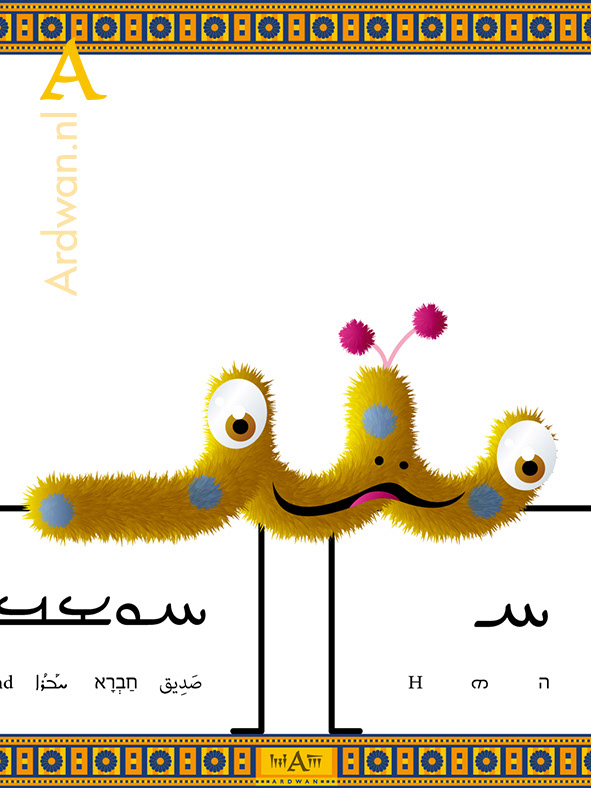
From an alphabet book I made to teach Mandaean children their letters.
When a Mandaean has to explain to a new neighbour who we are, we almost always begin in the same place: we have our own language, and our own script. Not a dialect, not a borrowed alphabet. Something unmistakably ours. It is the first thing we reach for, because it is the thing that has not yet been taken.
We come from the south of Iraq and from Khuzestan, just across the Iranian border. That is where the faith lived for two thousand years, close to the rivers it depends on. Then came war after war. Persecution, the collapse after 2003, a peaceful people forbidden by faith to carry weapons and easy to prey upon. In a single generation most Mandaeans were pushed out of the homeland into a very recent Western diaspora: Australia, Sweden, the Netherlands, the United States. Perhaps sixty thousand of us, scattered.
What scatters is not only a population. It is a way of living the faith. We used to live close together, neighbours within reach of neighbours, a priest nearby for a baptism, a death, a question. Spread that across continents and the everyday machinery of the religion begins to seize. The priest is now a flight away. The river no longer runs past the door.
And underneath it all, the language slips, layer by layer. Across the last century most Mandaeans gave up speaking Mandaic and turned to Arabic, keeping the old tongue for prayer and ritual. Now even that shared Arabic is thinning, as a new generation grows up speaking Dutch, Swedish, English, etc... Each move, each border, each generation strips away another layer of what we once had in common. And when the spoken language goes quiet, the written script is what remains to hold on to. It becomes the anchor of who we are.
You can see this in the smallest, most moving way. Among the very first things Mandaean communities make in exile are little books to teach their children the letters. A people that has lost its land, its rivers, much of its language, and what does it reach to save first? The alphabet. The shapes themselves.
I am one of the sixty thousand. I was born in Baghdad, my family comes from Shushtar, I grew up in the Netherlands. I have crossed borders my whole life, and I learned early that for us a border is only ever someone else's line on someone else's map. What we belong to is older than any of those lines, and we carry it in the letters.
So this is what exile really threatens. Not a building, not a place, those are already lost. It threatens the thread: priest to child, hand to hand, the script passed on while everything around it changes.
A scattered people survives by what it carries. The question, always, is who keeps carrying it.