
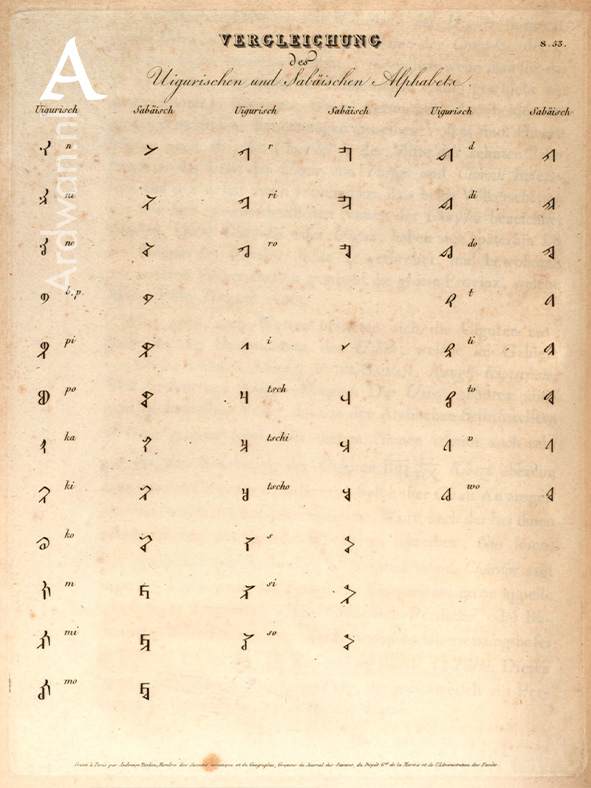
Comparative table of Uyghur and Mandaic script. Klaproth, 1820.
Around 1204, on the steppe after the defeat of the Naimans, Genghis Khan captured an Uyghur scribe named Tata-tonga and ordered him to fashion a script for the Mongolian language. The decree was a spoken one, given by a man who could not read or write himself. Tata-tonga did as he was told. He took his native Uyghur letters, set them vertically down the page, and gave the Mongols their writing. The script he made became the script of the Khans, and a thousand years later it is still in use in inner Asia.
The standard account of where the Uyghur script itself came from is well settled. It descended from Sogdian, the Iranian-language script of Central Asian merchants. Sogdian, in turn, descended from Aramaic, the great parent script of the Semitic world. The Aramaic branch most often named as the bridge to the steppe is Syriac, carried east by Christian missionaries and merchants along the silk routes.
This is the account you will find in every standard reference. It has the weight of repetition behind it.
There is, however, another notation that runs quietly alongside it. Older than the standard account, and made by three serious scholars in three different countries across more than a century.
In 1767, the Oxford scholar Gregorio Sharpe edited and published the second volume of Thomas Hyde's unfinished oriental work, Syntagma Dissertationum, from the Clarendon Press. At the back of the volume, on the seventh of the engraved plates, Hyde placed two alphabets in one field of view, and across them, in his own hand, wrote a single line of English. The Mendean Alphabet adhering to The Tartar Alphabet of those who govern China. The Mendean was the Mandaic. The Tartar was the script descended from Uyghur, the script of the Khans. Adhering to. The phrase is not decorative. In the English of his day it meant fastened to, attached to, belonging with. Hyde, working from his own manuscripts now in the British Museum, did not write the two alphabets next to each other and leave the reader to guess at the relation. He labelled the relation. Mandaic, he said on the plate itself, holds to the Tartar script. In the most respected Bodleian study of its day, in eighteenth-century Oxford, those two were named in the same breath.
In 1820, the German orientalist Heinrich Julius Klaproth took the next step. In his Abhandlung über die Sprache und Schrift der Uiguren, published in Paris by the Royal Printers, he placed a comparative plate, titled in his own hand Vergleichung des Uigurischen und Sabäischen Alphabetz. A comparison of the Uyghur and Sabian alphabets. Sabian, in his day, was the European name for what we now call Mandaic. The Mandaeans had been known to some Europeans as Sabians in the seventeenth century, after the Quranic Sabi'un, the people of the book named alongside Jews and Christians. On the plate, the Uyghur and the Sabian, the Mongolian ancestor and the Mandaic, are set side by side letter by letter, sound by sound: n against n, ni against ni, no against no, all the way through.
And the plate is not the whole of it. In his text, on the pages opening that chapter, Klaproth says what the plate is meant to show. The Uyghur script, he writes, descends from the Syriac letters brought east by Nestorian priests. That much is the standard story, in his day as in ours. And the Uyghur does carry traces of the Syriac, einzelne Ähnlichkeiten, individual, scattered resemblances. But with the Sabian alphabet, he writes, the Uyghur stimmt auch vollkommen mit den Formen und Sylbenverbindungen überein. It agrees completely, not only in single letters but in the whole shape of the script and in the way the syllables join. Vollkommen. Completely. The word is his, in the running prose, in a published reference book in 1820.
Sixty years later came the heaviest blow to the standard account, and it came from inside the standard account itself.
In 1880, Carl Faulmann published Das Buch der Schrift in Vienna, the great compendium of the world's writing systems that has been a reference for paleographers ever since. He opens his chapter on the Tartar and Mongolian scripts with a sentence that is hard to read with a straight face today. "With what superficiality the descent of these scripts has so far been judged," he writes, "is proved by the fact that paleographers consider it settled that the Tartars and Mongols took their script from the Syrians." The mainstream of the field, he says, has set the Syriac thesis up apodictically, dogmatically, and has set aside everything that speaks against it.
He then does what no one before him had done. He prints a three-column comparative table: Nestorian Syriac on the left, Tartar (Uyghur) in the middle, Mandaic on the right, with the sound values along the side. Letter by letter. And he draws the only conclusion the table allows. Some of the Tartar signs lean toward the Nestorian Syriac. Others lean toward the Mandaic. The script of the Khans, in his reading, has not one Aramaic parent but two.
The rest of his chapter is a quiet, careful argument against the dominant Syriac-only thesis. He engages with Ármin Vámbéry, the most famous Turkologist of the period, who had defended that thesis, and shows where it does not hold. Syriac, he points out, had perfectly serviceable letters for b, d, g and z, and the Tartars did not take them. If the Syrians had brought the whole script east, why did the most distinctive Syriac letters not make the journey?
Three publicly available volumes. Three independent scholars, working in three different countries more than a century apart, who each in their own way placed Mandaic next to the script of the Khans. Hyde, on the plate itself, called the Mandaic alphabet adhering to the Tartar alphabet of those who govern China. Klaproth set them out for systematic comparison and wrote, in his own running prose, that the agreement with Mandaic was complete. Faulmann argued, in print, that Mandaic was one of two sources, and accused the field of dogmatism for refusing to see it.
After Faulmann, the line goes quiet. For nearly a hundred and fifty years no one has taken up his argument in the open literature, as far as I can find. The standard account has settled on Syriac as the Aramaic dialect that travelled north, and Mandaic has slipped out of a conversation it had been visibly part of since the eighteenth century.
So. Did Genghis Khan write Mandaic?
No. He was illiterate. He never wrote anything at all. The script he commanded into existence was Mongolian, fashioned by his Uyghur scribe from the Uyghur letters that scribe already knew. That much is well established and not seriously in dispute.
The interesting question lies underneath that easy one. Did the script he set in motion share with Mandaic an Aramaic kinship closer than the standard account allows? Three independent scholars between 1767 and 1880, including one who said so in plain words in a reference book that is still on the shelf, thought it was. Faulmann did the work, and the field walked past it.
So no, Genghis Khan did not write Mandaic. But the letters the Khans left behind, and the letters my ancestors wrote in southern Mesopotamia, were placed alongside each other on three serious plates over more than a century, and one of those three scholars argued, on the page, that they belonged in the same family in a way the field has refused to look at since.
That is, at minimum, a question still worth asking.