
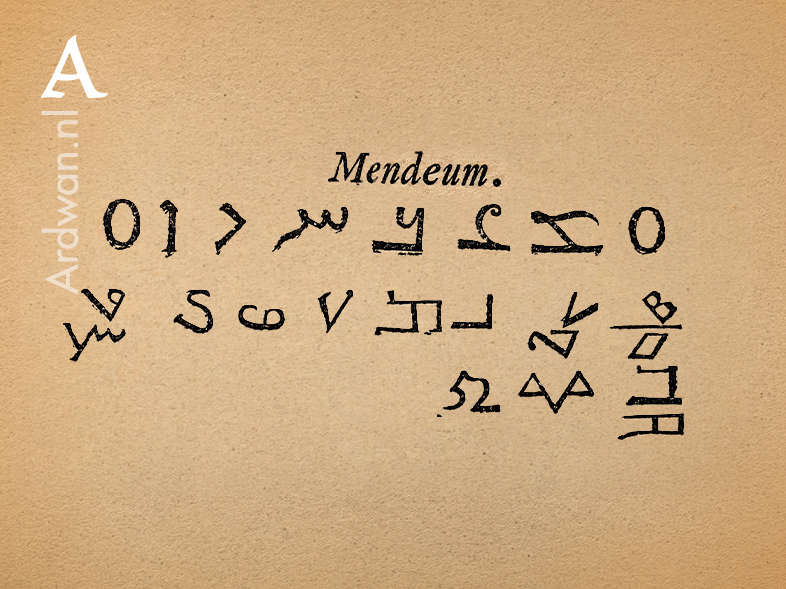
"Mendeum." An early European attempt to print the Mandaic alphabet. Without proper Mandaic type, the printers improvised, rotating and combining Latin and Greek letters into shapes that resembled the originals.
Europe's First Glimpses
In the nineteenth century, the German scholars who had taken up the systematic study of the Mandaeans gave the question that puzzled them a name of its own. They called it die Mandäerfrage, the Mandaean question. It has carried that name in the academic literature ever since, and Christa Müller-Kessler has, in our own time, fixed it as the standard label under which the debate is now conducted. What it asks is straightforward enough to state. Who are these people, where did they come from, in what tradition does their script and their religion belong, and how did they end up in the marshes of southern Mesopotamia. The questions have not been settled in three centuries of trying. The literature on them is now long, careful, and still unresolved.
Across three Marginalia posts I want to walk through the long arc of this question. Part 1, today, is about how Europe first noticed the Mandaeans and their script. Part 2, is about how the German universities and the field that grew out of them drew the map of the debate. Part 3 is about where the question now stands and what three centuries of careful work have refined without resolving.
A word first about what the script is, before I tell you how Europe came to ask about it. The Mandaeans call it the Abagada, after the names of its first letters. Twenty-four letters, each with a name and a number value, written from right to left. It is the script of one of the world's oldest continuously practised religions, used for the canonical religious texts of the community, for the lead amulets and clay bowls of late antique Mesopotamia, and for the colophons by which scribes have passed the texts down across centuries. It is still in use today, written by the priests of the community in the south of Iraq and in the diaspora that now extends out from there.
For most of European history, the script remained out of reach. The Mandaeans have always lived in the southern part of Mesopotamia and Elam, far from the Mediterranean trade routes that would have brought their writing into European hands. The medieval missionaries who did reach them, beginning already in the late thirteenth century, sent letters back to Rome about the community they had found, but the script as a thing to be studied and set into European print was still a long way off. It existed, in its own corner of the world, for a thousand years and more before any European press tried to put it down.
Three centuries ago, that began to change. Missionaries and travellers reaching the south of Mesopotamia met a community of baptisers who wrote in letters unlike any they had seen, and they did what curious Europeans of the period tended to do: they tried to bring it home in a book.
The trying is the part I want to dwell on. European presses of the period had no Mandaic type. So when an editor or a learned librarian wanted to put these letters in print, the printer reached for what he had: Latin letters, Greek letters, the odd Hebrew shape, an old numeral. He turned them on their sides. He combined two into one. He flipped them upside-down. He set the result under the heading "Mendeum" and called it Mandaic script.
It is a touching kind of failure. Trained European eyes, working hard to see something genuinely other, kept finding their own letters reflected back at them in disguise. They reached across the world's distance for an unfamiliar script, and got, in the end, a row of familiar shapes pretending to be foreign. A more careful line of work ran alongside this, with engraved plates copied directly from manuscripts, and these are closer to the originals. But even copying is not the same as understanding.
I know that distance well. I have set the Mandaic letters into modern typefaces from the manuscripts themselves, the manuscripts none of these early printers had to hand. The shortcuts they took, the rotated Hebrew, the flipped Greek, the upside-down Latin, are the shortcuts a designer working from inside the tradition does not take.
The cast of people who took the trouble to do any of this work was small and quietly persistent. A Dominican friar from Florence, Riccoldo da Montecroce, travelled through Mesopotamia in the late thirteenth century and met the community on the riverbanks, the first European writer to describe them by name. Nearly four centuries later an Italian Carmelite, Ignatius a Iesu, who had lived among the Mandaeans in Basra, published in Rome the first European book devoted entirely to them. He wrote it in the dry register of a missionary trying to refute what he had also clearly come to admire, the man who had spent enough time in their houses to know what their bread tasted like.
A little later the French traveller Jean de Thévenot reached Basra, on a journey that would also take him to coffee shops in Cairo and an audience with shahs in Persia, and would end, before he was thirty-five, with his early death on the road from Tabriz. He described the Mandaean script in passing, as one of the strangest things he had seen on a road that had already shown him a great deal.
Back in Oxford, Edward Bernard, an astronomer who had become an orientalist almost by accident, set the Mandaic letters into his table of the world's writing systems, working from his study with copies passed hand to hand between scholars. His Bodleian colleague Thomas Hyde, who would write the founding European book on Persian religion, kept a chapter for the Mandaeans, transcribing their letters from copies he never travelled east to see.
The German naturalist Engelbert Kaempfer set the letters down in his great compendium of exotic curiosities, alongside sketches of Persian palaces, Japanese gardens and the date palm he had drawn from a tree in Bandar Abbas, an obsessive observer who seemed to draw everything he saw twice, once for the page and once for himself. And at the end of the eighteenth century the Danish surveyor Carsten Niebuhr put the Mandaic letters into his Arabian survey, the sole survivor of a six-man royal expedition whose other five members had died of fever and exhaustion in Yemen, a man who had learned, the hard way, what details cost.
By then the script had become a respectable entry in the great catalogues of the world's writing. I have made a selection here. The full company of these early observers, what they wrote and what they got wrong, belongs in longer work. But none of them, however careful their eyes, could yet say what this script actually was, or where, in the long history of writing, it belonged.
Each of them noticed. None of them could place it. And three centuries on, that is still the question being asked. I am one of the people working on it now, from inside the tradition they reached toward.