

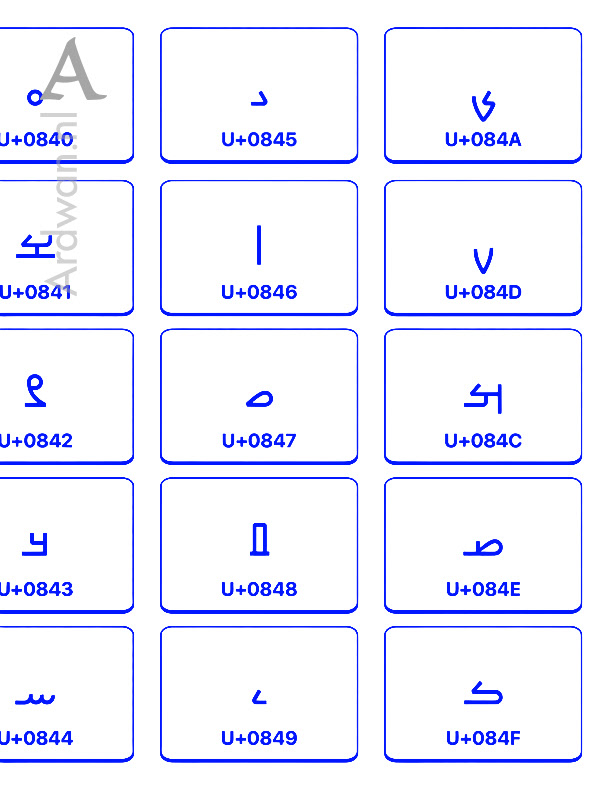
The Mandaic Unicode block, U+0840 through U+0858, set in one of my typefaces.
ࡀࡁࡀࡂࡀࡃࡀ, The Mandaic letter at the start of this sentence, ࡀ, has a number. The number is U+0840. Anywhere in the world that someone types that letter, on whatever device, the machine knows what is meant because it knows U+0840. That number is part of an international agreement called Unicode, a system under which every letter of every script in the world has, somewhere, a position. It is, for what it does, the quietest large project of our time.
Each script has its own block of positions in the Unicode table. Latin has a block. Arabic has a block. Chinese has several. The Mandaic script has had one since 2010. The block runs from U+0840 to U+085F. Twenty-five letters, three diacritics, one mark of punctuation. Twenty-nine occupied positions in total, with three reserved gaps for whatever the future may bring. For most of the world's scripts that is a small share of space. For the Mandaic script it is everything the script has digitally.
A block of this kind is not a small undertaking. Each letter has to be entered into the table at the right position, with the right name, with the right behaviour beside other letters, with the right line-breaking and shaping rules. For every script in the world, someone, at some point, has had to do this work. For Mandaic, the work was done by an Irish encoder named Michael Everson, who in 2008 prepared the first proposal for the Mandaic block. The Unicode Consortium accepted his proposal that summer, and in 2010 the block appeared in Unicode 6.0. That was the first time the Mandaic script had its own address in the world's digital infrastructure. Mandaeans had been writing Mandaic on computers for years before that, with fonts that placed Mandaic letterforms inside the Hebrew or Arabic Unicode blocks. I had made a few of those myself. They worked, but only when both the sender and the reader had installed the same font. With its own block, the script could finally travel across the internet on its own terms.
Everson is not a Mandaean. He worked from the published scholarship he could reach, and from advisers willing to consult with him. That is how Unicode usually does this work. When a community does not yet have someone ready to come in and write its letters into the table, someone else does it, as well as he can, from outside. The absence of the community is not unwillingness. In most cases it is a kind of patience. The script waits for whoever in the community is ready.
When the Mandaic block appeared in 2010, I had already been making Mandaic fonts, working around the limitations of the existing system. The year after, I began my graphic design studies at St Joost. With the new block in place, I could begin in earnest. What had been done in Unicode was, for me, a small wonder. The script we had carried for centuries on paper now had a place in the table that carries the world's writing.
The moment I started using the block, though, I saw something that needed attention. A few of the letters, when placed after another letter, would sit on their own, the way an English letter sits on its own after a space. In every manuscript I knew, in every priest's hand I had watched, those letters joined. In the standard they did not.
I understood why this had happened. Some of the joining behaviours of the Mandaic script are subtle enough that you only see them once you have copied the manuscripts yourself, or sat beside a priest as he wrote, or grown up at the desk of your father as he finished the colophon at the end of a book. They do not come through clearly in printed scholarship. They come through in the hand. Whoever prepared the block had been looking at the script from outside, with great care, but from outside.
For nine years I worked on other parts of the script. I made more typefaces. I read more colophons. I studied the way the older scribes had let their letters lean into each other across the centuries. By the autumn of 2019 I was ready to come back to the block. I wrote a letter to the Unicode Consortium. The opening line of that letter I can still recall: "I am writing you because of my love and appreciation for your work." That was true. What had been done in 2010 was generous. I was not coming to complain. I was coming to add.
The work that followed was patient and ordinary. I took the letters that the standard would not let join, and for each of them I looked in our family collection, the RRC, for manuscripts that showed otherwise. Manuscripts from 1674, 1675, 1716, 1753, 1890, 1897, 1950. For each letter I prepared a separate technical document, with the photographs, the dates, the names of the copyists, an explanation of the current entry in the standard, and the change being requested. The documents went, in December 2019 and January 2020, to Berkeley, to the Script Encoding Initiative that coordinates proposals for the Unicode Consortium. In March 2020, Unicode 13 was released. The changes were in it.
Since then, in the file called ArabicShaping.txt, the letters in question carry the letter R where they used to carry the letter U. R for right-joining, U for un-joining. A change of one character per letter, in a configuration file that no Mandaean will ever open. For a reader who does not know the script, invisible. For a reader who does, the difference between one Mandaic word on a screen and another.
What is strange about this kind of work is that it lives everywhere and nowhere. Whoever in Sydney or Stockholm or Nijmegen types a Mandaic name today is using rules that were corrected in the spring of 2020. None of them knows that. The Mandaean diaspora is small, sixty thousand people give or take, spread across continents. For each of them, the script in their phone is the script of their grandfathers. It ought to join the way their grandfathers' hands joined it.
I put my name on this work because the script is too important to be repaired anonymously. Anonymity is the right register for routine maintenance. This was not routine. The Mandaic block in the standard is the one place where the script meets the global digital infrastructure, and what is there is what gets carried forward by the children who type Mandaic now, and by the children of those children. Whoever did the work, it had to be done well, and it had to be visible enough in the public record that a Mandaean a century from now could trace it back to a hand that knew the manuscripts.
The script goes on. The hands that carry it go on.