
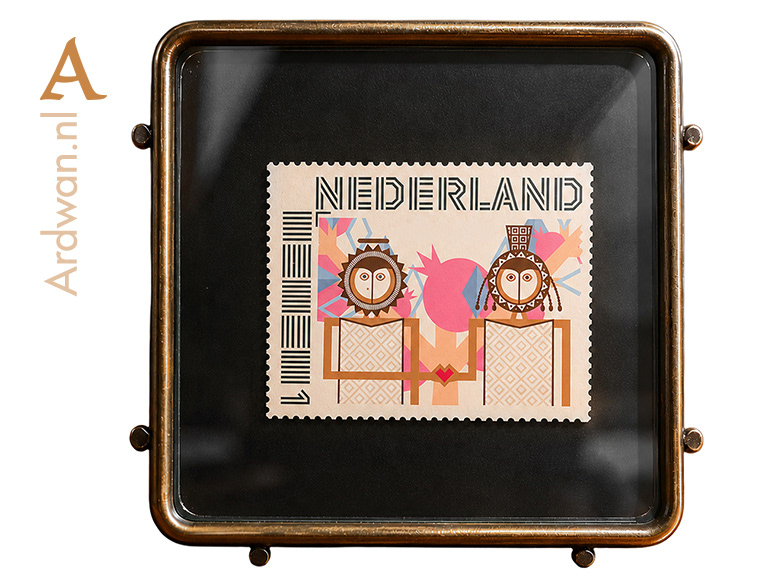
The Mandaean postage stamp, designed by Ardwan Al-Sabti, 2016. Printed by PostNL and valid as postage in the Netherlands.
In August 2016, in the Netherlands, an envelope went through the post with a stamp no one had seen before. It was small, in pink and blue and brown on cream. Two figures stood on it, drawn in a style far older than the postal system that carried it.
The stamp was Mandaean. It was a personal stamp, made through PostNL, and valid postage like any other. I used that door. As far as I have been able to determine, it was the first Mandaean stamp ever printed. It was delivered to addresses in cities where almost no one had heard of the Mandaeans.
There has not been one since. That is not because a stamp is hard to print. It is because the iconography has to be learned first.
Mandaean iconography is a system, and it is not learned at a glance. It has to be studied from inside, the way one learns a script. At the academy I spent my second large project working through it, with photocopies of the manuscripts pinned to the wall behind my desk. What looks at first like decoration is a structure. Spend long enough among the manuscripts and you can tell the figures drawn by one priest from those drawn by another, the way you can tell handwriting. What that structure is, and how to read it, is for another day.
Making is not imitation. To design a stamp in this tradition is not to copy old shapes onto small paper. It is to take the proportions of the manuscripts, their rhythms and their relationships, and apply them to something the manuscripts never drew. I built two figures, a couple, in the geometry the tradition has used for centuries. They stand side by side, and their hands meet in the middle.
The one thing I added was colour. For most of its history Mandaean iconography has been black on paper, with the rare touch of red. The geometry was always there. The proportions were always there. Colour was not. The red is still on the stamp. It is the small heart between their hands.
Somewhere in a drawer in this country there may still be an envelope with the two of them on it. Franked, delivered, opened by someone who did not know what they were holding. Last week I wrote about a Queen who was given our sacred book and could not read it. This is the same story, at the smallest possible scale. Our tradition has often travelled like this: unrecognised, and intact.