
Book of the ABGD. Breda, 2015
A few weeks ago, in the post about St. Joost, I wrote that I had done two large Mandaic projects at the academy, and that there were rules I keep around how the first one is spoken of in public. This is that first one.
I will say what it is. I will not say what is in it. The work itself has grown, over the years that followed, into the two book volumes I am writing now. So the what and the how belong in those volumes, and I keep them there. What can live here is the object, the year, and a stranger who saw it.
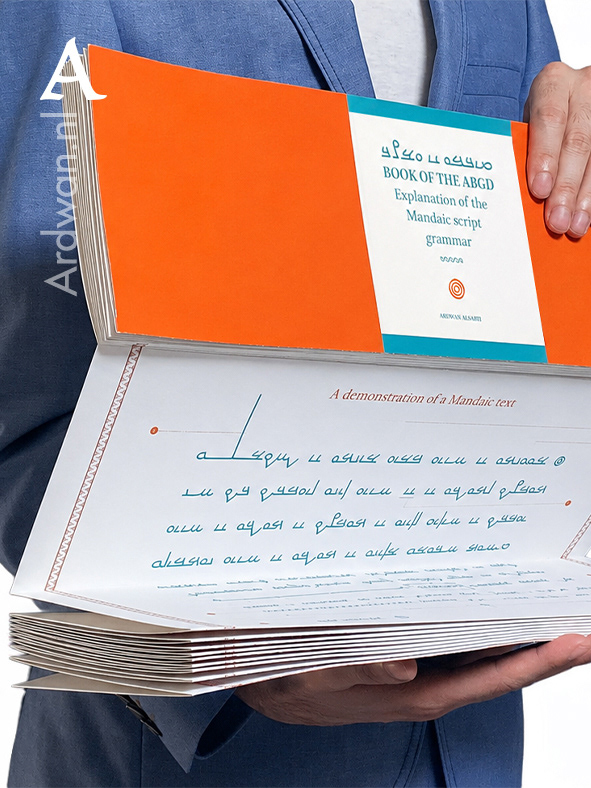
It is called, on the cover, Explanation of the Mandaic script grammar. I made it in 2015, in my final year at the academy. The two required graduation projects were elsewhere. This one was the work I had been carrying since my minor, into my internship, and now into the final year, because I could not put it down. I was twenty-seven.
The object is a lamella. A single long sheet, almost five metres in length and forty-eight centimetres tall, folded in zig-zag so that it can be held like a codex and pulled open like a scroll. It is bound in colour. The cover is bright. You need both hands to carry it. The form is not a Western book in the modern sense. It is closer to the way my ancestors carried their texts, an unbroken roll, only here translated into a fold so that a Dutch art academy could place it on a table and a visitor could turn the panels.
The form was not only symbolic. It did real work. Because the panels fold both ways, any two sections of the book can be laid open beside each other, however far apart they sit in the work. Fold the panels between them shut, and the two themes meet on the table. That is not how a Western book is read. It is how a scholar reads when he wants to compare two passages, side by side, at the same time.
That last detail matters, because that was the point. A small piece of a Mandaic tradition, reshaped just far enough that a stranger could approach it, and just useful enough that a reader who wanted to work with it actually could.
A stranger did. On 12 July 2015, after the graduation show in Breda, a Dutch culture blogger who calls herself the Argusvlinder wrote about my work. Each graduating designer had been asked to make a small document for the catalogue, and visitors could collect the documents of the students whose work spoke to them. Mine listed two pieces: posters for a music venue, and a project about being left-handed. The lamella was on the wall, but not on the document. She was left-handed. She loved pop music. By her own admission, the two on the document should have been the projects that pulled her in.
They did not. She wrote: "those two projects do not really draw me in. But the book that you see pictured above, much more so." She had never heard the word Mandaic before that day. She had to look up the people and the language on Wikipedia. And still, looking at this lamella she could not even fully leaf through during the show, she wrote one sentence at the end that I have carried with me for ten years:
"Hier zou ik graag meer van zien."
Here I would like to see more.
Marginalia, in a sense, is the long answer to that sentence.
The lamella did its job, then. It pulled in someone who had no connection to me, no reason to care, no prior context for Mesopotamia or Aramaic or any of the names a Mandaean takes for granted. It did so on a quiet wall of a graduation show, surrounded by hundreds of other student works competing for attention. That was the moment, more than the assessment grade, more than the diploma, when I knew the work was right.
What I could not yet articulate that summer, the words for it only arrived later, was that this was not a graduation project. It was a first attempt at a job. I had given myself an impossible brief, and I had answered it with a serious object, and a stranger had stopped in front of that object long enough to write about it on her own blog.
That recognition has shaped the ten years since. The Mandaic Unicode block I helped repair. The keyboard work for Apple. The typefaces I designed after Lidzbarski and after Euting. The book that has been growing in the evenings ever since, the what and the how I keep for itself. All of it began, in any visible form, in this lamella on a wall in Breda in the summer of 2015.
The work is in my own hands today. I keep it close. Few people have seen it open, because the rules I have around it are strict, and the deeper work belongs in the volumes I am writing. But it exists. It is heavy. And it was made by a twenty-seven-year-old who did not entirely know what he was beginning, but knew enough to make the object as seriously as he could.
That is all I can show you here. A photograph, a few details, and a stranger's sentence.
I have kept doing the work.