
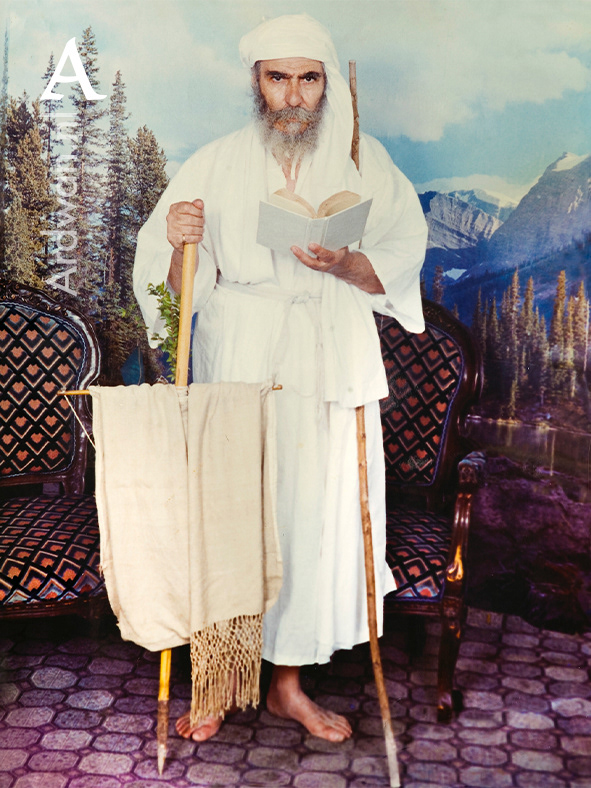
Ram Yuhana, head of the Mandaeans worldwide.
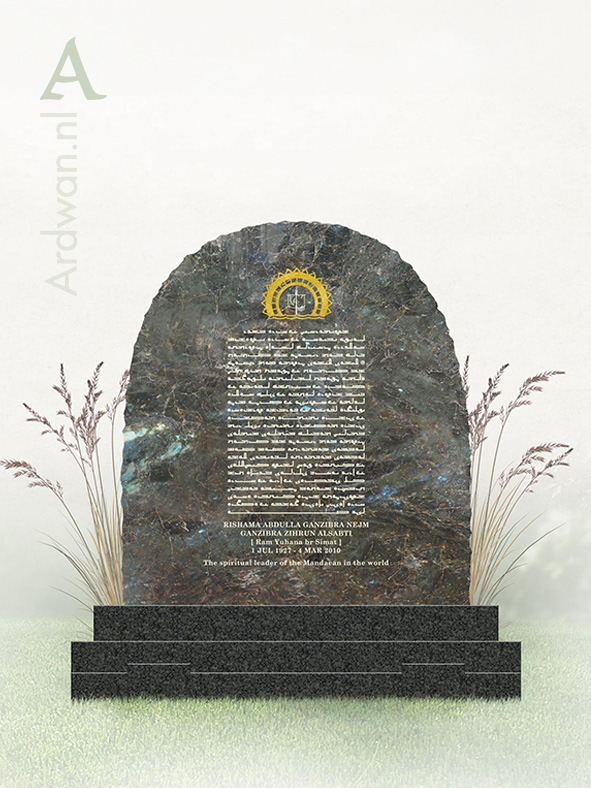
The gravestone I designed for him.
In the last post I ended on a question: when a people scatters, who keeps carrying the faith? Here is one answer. My grandfather, Ram Yuhana, known in Arabic as Rishama Abdulla the second.
He was born in 1927 in Qalat Salih, in southern Iraq, twenty-second generation in the verified priestly line that reaches back to the king Ardwan. He became a priest at seventeen. I did not read about him. I stood beside him at the riverside as a child, before I understood what I was standing next to.
In 1981 the previous leader of the Mandaeans died, and a delegation travelled from Baghdad to Basra to ask my grandfather to take his place. He did not campaign for it. The people came to him, because they judged him the only one fit to carry it. He became the leader of the Mandaeans worldwide. He was also the first Mandaean leader the Iraqi state ever formally recognised. For a people the state had always treated as too small to matter, whose priests and leaders had never once been granted that standing, this was something new.
The religious title of Rishama, the highest authority we have and the one others would compare to a pope, is not conferred by appointment. It comes through specific rites within the tradition. My grandfather received it in 1992. He was the first Rishama in more than a century. The last before him had died in 1872.
A plot of land in Baghdad had already been granted to the community by the state, and there it had sat, waiting for someone who knew what to do with it. He did. He organised the work, raised the means, gathered the hands, and on that ground he built the great Bit Manda, the House of Knowledge, our central temple. It stands there still, the centre of the Mandaean faith worldwide, the building he willed into being. And on the neighbouring plot, which was his own, he built the house he would live in, so that his own door and the door of the Mandi stood always within a few steps of one another. He wanted his life to unfold at the centre of the faith he had spent it protecting.
He inherited the office at the worst possible moment. The priesthood was dying out. By tradition only a few families could produce priests, passed strictly from father to son, and those families had run thin. A religion like ours cannot function without priests: only they can perform the baptisms and the rites that hold everything together. He could see the line about to break.
So he did something that took real courage. He broke the rule. To save the faith, he would train any worthy person, whatever family they came from. He trained more than twenty men, and ordained eight of them as priests with his own hands. Six of those eight are alive today, serving their communities in Iraq, the Netherlands, Sweden, Denmark, the United States and Australia. When you read that Mandaean baptisms still happen across the diaspora, this is part of why. He scattered priests on purpose, ahead of the people, so that wherever the people landed, the faith would already be there.
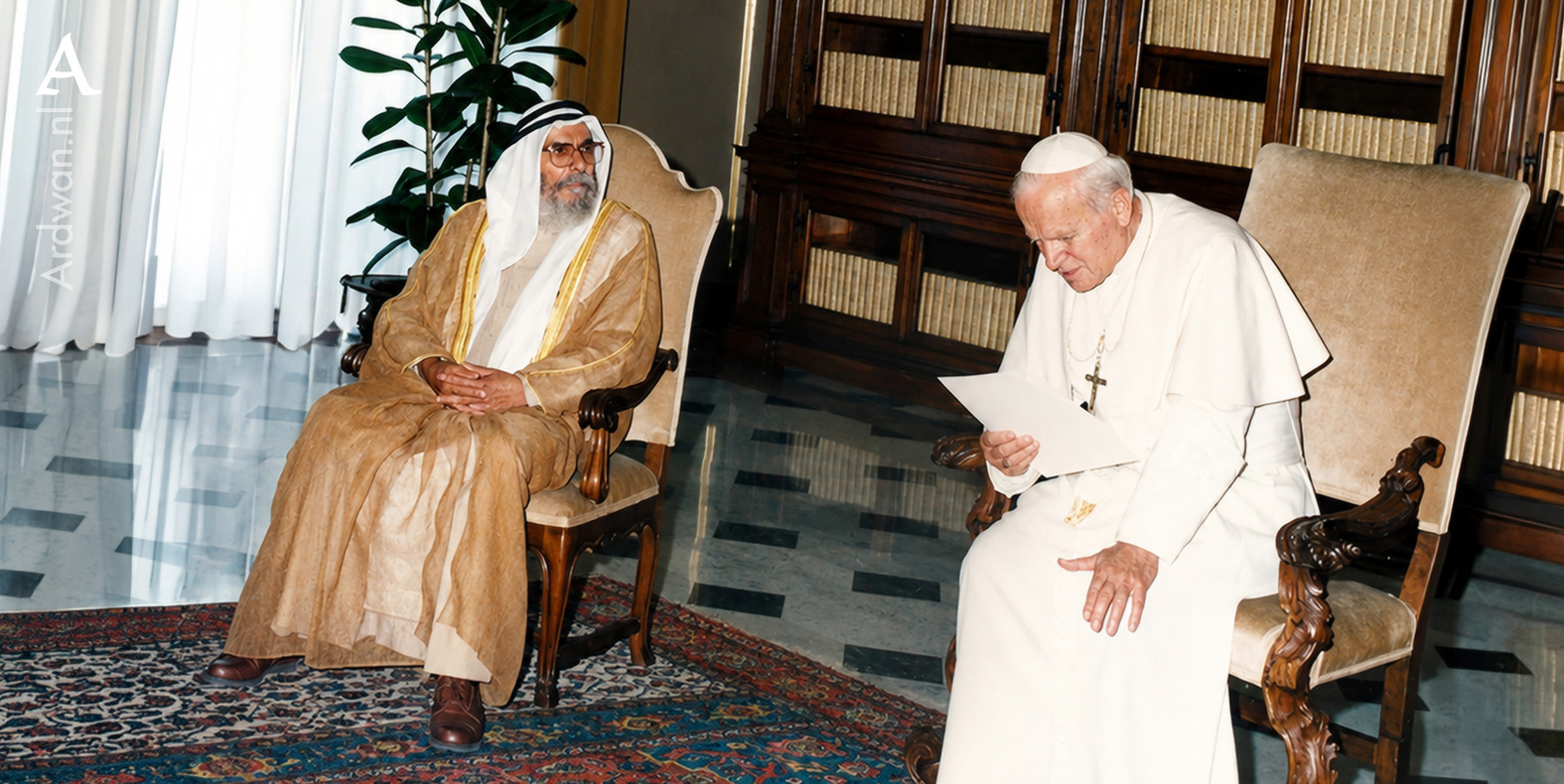
That was his whole instinct: keep the faith exactly, but let the practice move with the time, so that it could survive a century he could already see coming. He loved history, and he loved justice. His office also carried him into rooms most priests never enter. In June 1990 he led the first Mandaean delegation received at the Vatican, where Pope John Paul II welcomed him and called his people "your cousins"; the address is still in the Vatican's own records. He met Mother Teresa as well. When the world wanted to speak with the Mandaeans, he was the man it received. He carried the ritual into exile and never set it down, and he settled, in the end, in the Netherlands, where he died in 2010.
On his gravestone, beside the ritual words that bless a soul leaving this world for the world of light, two symbolic rivers flow out from under the stone. They are there because they recall the Tigris and Euphrates of Mesopotamia, because ours is a faith of living water, and, more simply, because he loved to swim. I designed the Mandaic letters carved into that stone. I think about it often: the grandson who shapes letters for a living, cutting them for the man who saved the people those letters belong to.
He measured a person not by rank or wealth but by one thing: whether they stood up for their people and against injustice. The ones he admired were the ones who defended the powerless, and he lived it himself. He never reached for power; when leadership came, it came because the people walked to his door and he carried it with responsibility.
One of the last things I learned from him directly, I learned it when visiting him in Manchester, where he lived for a while. Mandaeans still came to his door the way they had in Iraq; nothing about that had changed. One of them asked the question everyone was afraid to ask: Rishama, after you, will Mandaeism end? My grandfather answered simply. "It will not end," he said. "Even if there is no priest left, it is enough for a father to pour water over his son's head and speak in the name of the House of Life." He had given his life to saving the priesthood, and still he believed the faith would outlast even that, surviving in the smallest act of a parent and a little water. I was too young to understand it then. I understand it now.
This is the man I come from. I grew up at the edge of his rituals, by the water, learning by watching, the way the children of priests always have. He carried the priesthood through the moment it almost vanished. I carry the letters. It is the same chain, and it is part of why I do what I do.