
Julius Euting is my idol. I have never had to think about it.
He was born on 11 July 1839 in Stuttgart and died on 2 January 1913 in Strasbourg. Between those two dates he became the most cited name in Semitic epigraphy of his generation. He studied theology and oriental languages, worked as a librarian first in Tübingen and then, from 1871, at the new Kaiser Wilhelm University library in Strasbourg, where he became director in 1900. He was an honorary professor, not an ordinarius. He never got the chair he was good enough for. He built his authority through work, not through title. That is why I love him.
There is one moment in his life I would have wanted to walk into.
It is 1865. Julius is twenty-six. He has been waiting for months on Mandaic manuscripts from the imperial library in Paris, manuscripts he needs for the work that will become his Qolasta. He is staying with his brother Franz, the mustard manufacturer, in the small town of Lahr, just across the Rhine from the French border. The post is slow. The manuscripts do not come. He picks up a porcelain coffee cup and saucer and begins, by hand, to paint it.
He paints a coffee cantata on it. A small lyrical text in praise of mocha. He writes it in three scripts, Mandaic, Arabic, and German. He arranges the Mandaic in three concentric rings on the saucer, working from the outer rim inward toward the centre. In the very same years, the first Mandaic incantation bowls from Mesopotamia had entered the British Museum, and entered European scholarship through Layard's 1853 book. The bowls carried their incantations in concentric rings of script, exactly the move Julius made on his saucer. He was a young oriental scholar in his brother's home, waiting for his manuscripts, and he made himself a private joke that was also a very serious tribute. A small magical Mandaic vessel of his own, holding coffee instead of an incantation. The cup, the Lahrer Tasse, is still kept at the Heimatmuseum in Freudenstadt.
Two years later, in August 1867, the manuscripts had come and the work was done. He published the Qolasta in Stuttgart. He dedicated it to three people. His teacher Rudolf von Roth in Tübingen. His friend William Wright at the British Museum in London. His friend Theodor Nöldeke at Kiel. The same Nöldeke I wrote about a few weeks ago. The same Wright whose letter I keep in my own archive, written from the British Museum in 1867, sending Euting a transcription line by line from manuscript Add. 23,602.A, and a promise to introduce him in September to Mrs Wright. That letter, in his own hand, is part of the human substrate of this book. Three scholars, in three cities, working by post to put a Mandaic text into print for the first time in a serious edition.
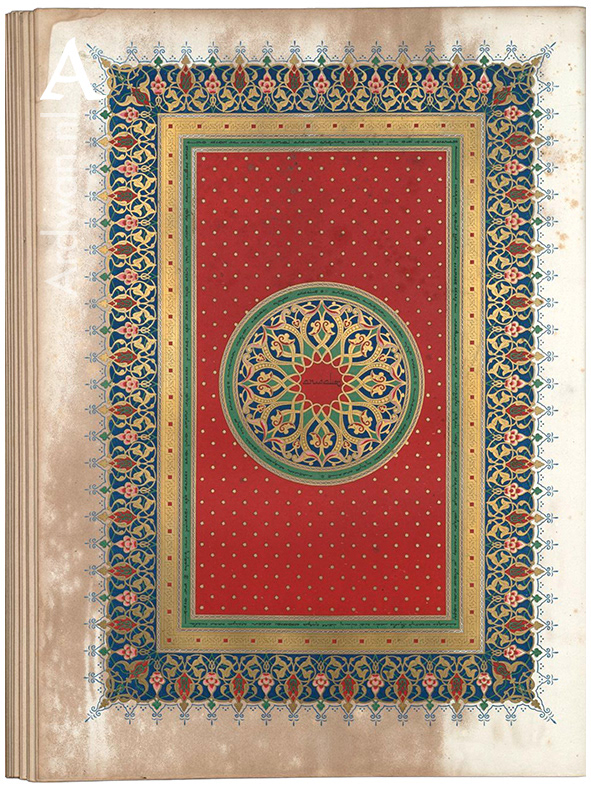
The frontispiece Euting designed for that book is the most beautiful page I know in nineteenth-century oriental scholarship. Deep red ground scattered with gold dots. A central medallion of interlaced arabesques in green, gold, and blue. A frame of floral ornament in the Ottoman manner. A thin band of his own Mandaic calligraphy running quietly along the inner border. A European book in oriental finery. Whoever opens it knows, before reading a word, that the man who made it loved his subject.
In the preface, also in his own hand, he says something I keep close. He apologises to the reader for the graphic quality of the work, because, he writes, he had to learn the autographic technique while he was making the book. "Was die graphische ausführung betrift, so bitte ich um nachsicht, da ich die autographische manier erst zu erlernen hatte." Then he asks the reader, gently, to compare the later issues with the earlier ones, in the hope that the effort to do better will at least be visible. That is one of the most honest sentences I have ever read in a scholarly preface. A young librarian admits, in writing, that he taught himself the trade while he was practising it. He does not pretend to mastery. He pretends to nothing.
And in the next paragraph, he cites a few verses by Ibn al-Bawwab, the great eleventh-century Arab master of calligraphy, on the art of Arabic writing, and adds that those verses apply just as well to any other oriental script. Inside the same breath in which he admits he is still learning, he places himself in an eight-hundred-year tradition of calligraphic care. Humble about his own craft, absolute about the lineage he stands in. I do exactly the same thing.
He also made Mandaic letter punches. I built two of my own typefaces from his work. Ardwan Punch, and Ardwan Deco, drawn from the handwritten elements in his punch letters. The rest belongs in the book. The line continuing his work in Mandaic type today is short. The line working from inside the tradition his scholarship served is shorter. I work on both.
He died in January 1913 in Strasbourg. He had loved the Orient all his life, and he had loved Arabic coffee from his travels. In his will he wrote one final instruction. Every year, on his birthday, the eleventh of July, a cup of mocha should be brewed over an open fire and offered to whatever lonely walker happened by. More than a hundred years later, this is still done. Every July eleventh, mocha is boiled over flame and poured for strangers in his name. He knew his life of coffee and the Orient would outlast him by exactly as long as he arranged for it to.
This is the man I keep returning to. A scholar without a chair. A librarian who drew his own Mandaic frontispiece and admitted, on the page, that he was still learning. A friend who put Nöldeke's and Wright's names beside his own teacher's at the front of his book. A man who painted his impatience onto a porcelain cup in three languages while he waited for the post. A man who arranged, before he died, that strangers would drink Arabic coffee for him a century after he was gone.
I never met him. He died seventy-four years before I was born. But I sit with his pages, his frontispieces, his letterforms, almost daily. I follow the marks his hand made. And every July eleventh, someone pours a cup of mocha for him.
This was my master.