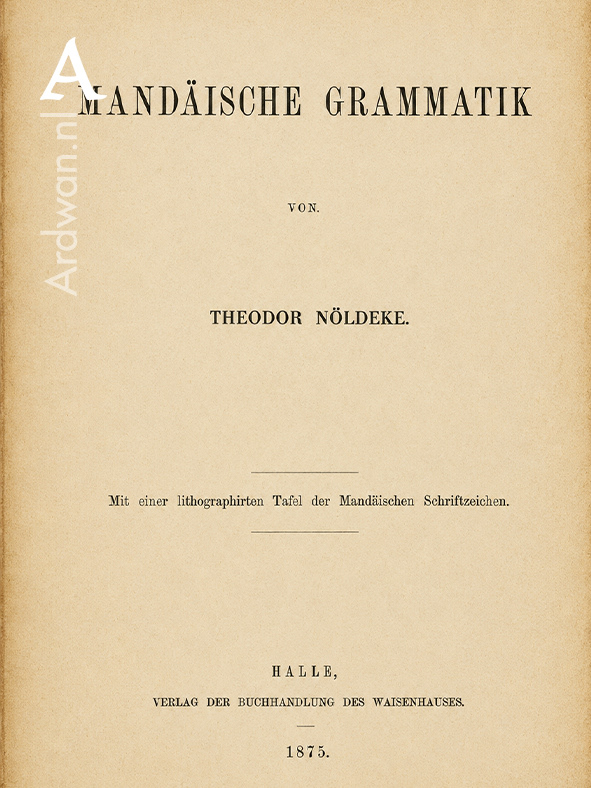
The grammar of Mandaic, set in another script. Nöldeke, Halle 1875.
In 1875, in Halle, a thick book appeared on the desks of European orientalists: Theodor Nöldeke's Mandäische Grammatik. Four hundred and eighty-six pages of morphology, syntax and a lithographed letter chart, published by the orphanage press of a German Pietist foundation. It was the first grammar of Mandaic ever written. It is, in serious philological terms, still the grammar.
Nöldeke was thirty-nine when it appeared, and already a figure in his field. He had taken his doctorate at Göttingen at twenty, studied under Heinrich Ewald, and held chairs at Kiel and, from 1872, at the German University of Strasbourg. By the time he turned to Mandaic he was working across Arabic, Hebrew, Aramaic, Syriac, Ethiopic and Persian, and his earlier Qur'an scholarship had already set the period's standard.
He had been thinking about the language for more than a decade. His first Mandaic study, Über die Mundart der Mandäer, had appeared in 1862 in the proceedings of the Göttingen academy. The 1875 grammar was the patient continuation of that early piece, broadened, deepened, and shaped into a reference work that everyone after him would have to begin from.
What the book gave the field is hard to overstate. The phonology, the verbal system, the noun classes, the syntax of the Mandaic language were laid out with the rigour Nöldeke brought to everything. Every later grammar, Macuch in 1965, the dictionary Drower and Macuch finished in 1963, the modern handbooks, all of them rest on what he set down. He did the foundational work, and he did it well enough that the foundation has not had to be replaced.
There is a curious detail in the book itself. In the body of the grammar Nöldeke set his Mandaic forms in Hebrew square script and in West Syriac Serto. The Mandaic letterforms themselves appear only once in the whole volume, on a single lithographed plate at the back. The grammar of the language was set, throughout, in letters that were not the language's own.
I notice this detail as a designer. To write the grammar of a script in another script is a choice, not an oversight. By the time a Mandaic type existed, his grammar was already set, throughout, in letters not its own. The long labour of bringing those letters into modern type, from the manuscripts themselves, is the work I have given my hand to.
He also offered a view on where the script came from. He placed it in the western Aramaic family, closer in lineage to Palmyrene and Nabataean than to anything further east. He grouped Mandaic with the scripts he could best compare it against, on the basis of the manuscripts European collections then held and the comparative tables of his teachers' generation. This was not a guess. It was a reading of the material available to him, against the wider Semitic landscape he already knew in detail. It was the answer the evidence in his hand, in his decade, could support.
Later scholarship has continued to test that view against material that has surfaced in the century and a half since. Magic bowls, inscriptions from the eastern margins of the late Aramaic world, closer study of the southern Mesopotamian scripts: none of these were on his desk when he wrote. He worked with what was knowable in 1875. That is the only thing any scholar can do.
He stayed in Strasbourg until he retired at seventy, and he kept publishing into his nineties. The Royal Netherlands Academy of Arts and Sciences elected him a foreign member in 1878. Imperial Germany awarded him the Pour le Mérite ten years after that. He died in Karlsruhe in 1930, at ninety-four. The grammar he had published at thirty-nine was, by then, still the grammar of Mandaic.
He had given the language its grammar, in letters that were not its own.
But there is another question, and it is the question I have been carrying for a long time. A language has a grammar. A script may have one too. Not the grammar of the language it carries, but a grammar of its own shapes, its proportions, its joins, its internal logic. The rules by which a Mandaic letter is, or is not, a Mandaic letter.
Nöldeke did not write that book. He could not have. It is a different book.
That is the question this post leaves open.