
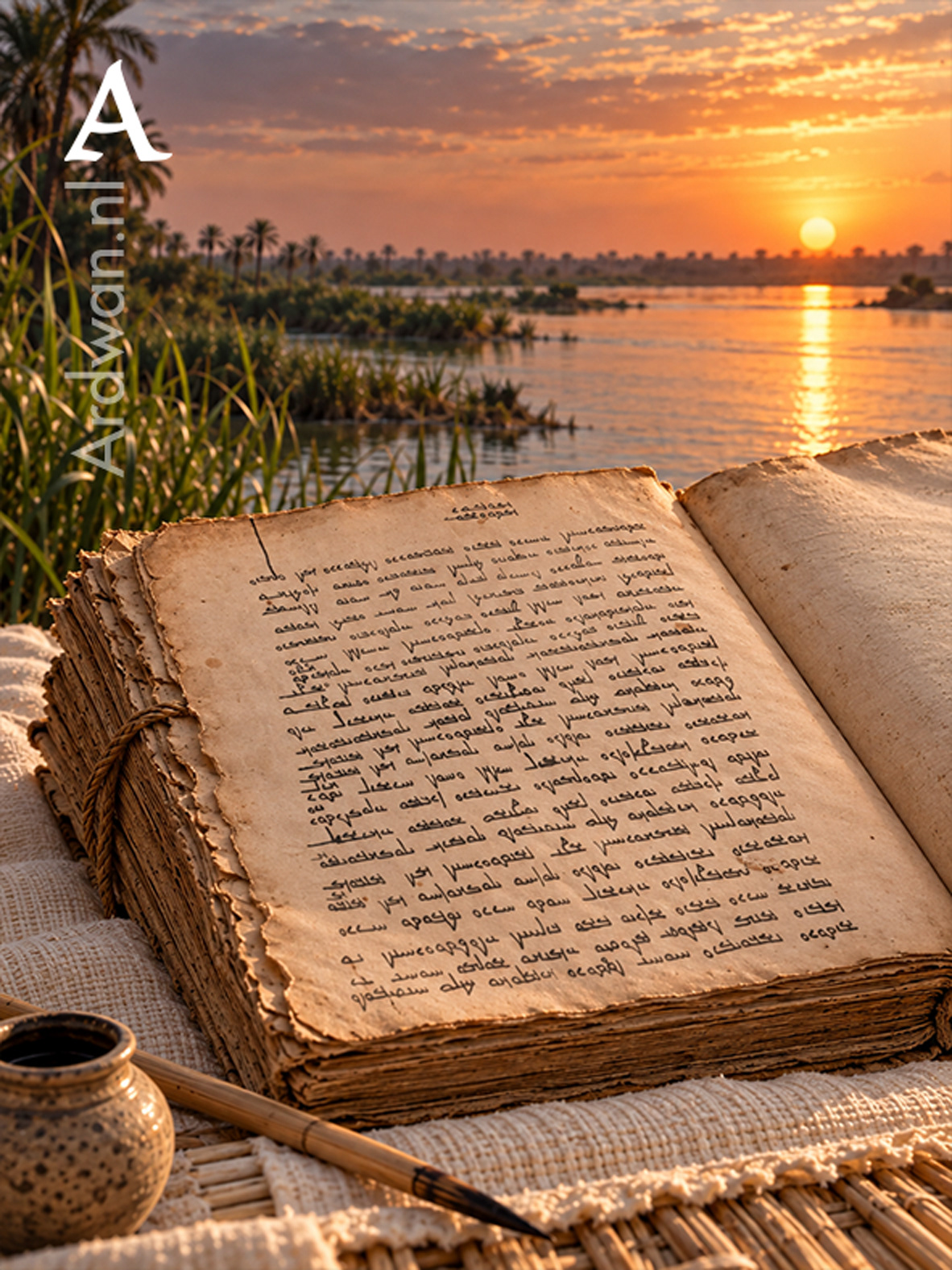
The opening page of Ganzibra Adam’s Ginza, written with his right hand. Illustration by Ardwan Al-Sabti.
In the British Library in London there is a Mandaean Ginza that once belonged to Queen Victoria. She could not read it. She had probably never heard of the people who made it. It came to her from a priest in southern Iraq, with a letter asking for her protection.
The Mandaeans were an ancient people of the rivers, whom their Western neighbours had largely forgotten. By the autumn of 1872 they were down to a few hundred families. Plague and famine. The Ottoman authorities and the local tribes were difficult. On 6 December 1872 Ram Zihrun, the head of the Mandaean nation, died at Mashrah on the Tigris. Four days later his brother-in-law, the priest Yahia Bihram, took up a reed pen and wrote a letter to the most powerful woman on earth, with the optimism that only a man of an ancient tradition can have.
He sent the Ginza with it. A manuscript of the Ginza d Hiia, the most sacred book of his tradition, copied by hand by his father, Ganzibra Adam, forty-five years earlier. It was heavy. It carried no illustrations, no gold, no ornament. It was the sacred text itself, hundreds of pages long, line after line of Mandaic. He wrapped it and handed it to Colonel Herbert, the British consul general in Baghdad. On 29 January 1873 Herbert sent it to the British ambassador in Constantinople, Sir Henry Elliot. On 26 February Elliot packed it inside another dispatch, this one bound for London, and sent it on.
The book travelled by mule. By steamboat down the Tigris. By ship across the Mediterranean. By train through Europe. By carriage to a corner of London where the Queen’s official correspondence was processed. Months passed.
It arrived. Someone opened it. The Queen of the largest empire on earth was given a sacred book in a script she could not read, from a people she had never heard of, sent by a priest she would never meet.
And then she wrote back. Twice.
The two letters went back along the same chain the book had come down. Mediterranean, Constantinople, Baghdad, the marshes of the lower Euphrates. They reached the priest sometime in 1873. He kept them.
But she had done more than write. She had also instructed her ambassador in Constantinople to press the Sultan for a firman of protection. The firman came. From then on, the Ottoman authorities in southern Iraq were instructed by their own emperor to leave the Mandaeans alone, to allow them their rivers and their faith. Yahia Bihram had given up his father’s last work. In its place his people received a piece of paper from the Sultan that kept many of them safe.
What the Queen could not have known was that the book was the last thing the priest’s father ever wrote. Ganzibra Adam had begun it in Basra in 1826, writing with his right hand. Halfway through, his right hand was taken from him. He finished the book the following year, with his left. After that he wrote no more. The book the Queen received was his last word, completed by the hand he had not been born to use. His son had kept it for forty-five years before sending it to her.
The book then went where it remains. It carries the shelf mark Or. 1236, and on its first page, in a fine copperplate hand, an English note records that it was presented by “Sheikh Yahya, Chief and High Priest of the tribe” with his petition to Her Majesty the Queen, dated 10th December 1872. Chief. In London they gave him the title four days after the man who truly held it had died.
The priest died some years later. His son inherited the two letters and kept them safely.
In 1918, when the British army had occupied Baghdad, the Civil Commissioner of the new British administration wrote to the priest’s son. Word of this had reached Baghdad. The Civil Commissioner wrote on official letterhead:
“I have been much interested to hear that you have carefully preserved these documents and I am glad to know that the son of the worthy father who received the letters is in good health. May they be an abiding pledge of ancient friendship between the British Government and the Sabaean community.”
Ancient friendship. Between the British Government and the Mandaeans. Forty-six years after the Queen wrote back.
The Ginza is still in London, under a note that calls Yahia Bihram chief. In the family it was remembered differently: as the last book Ganzibra Adam wrote, the one he finished with his left hand.