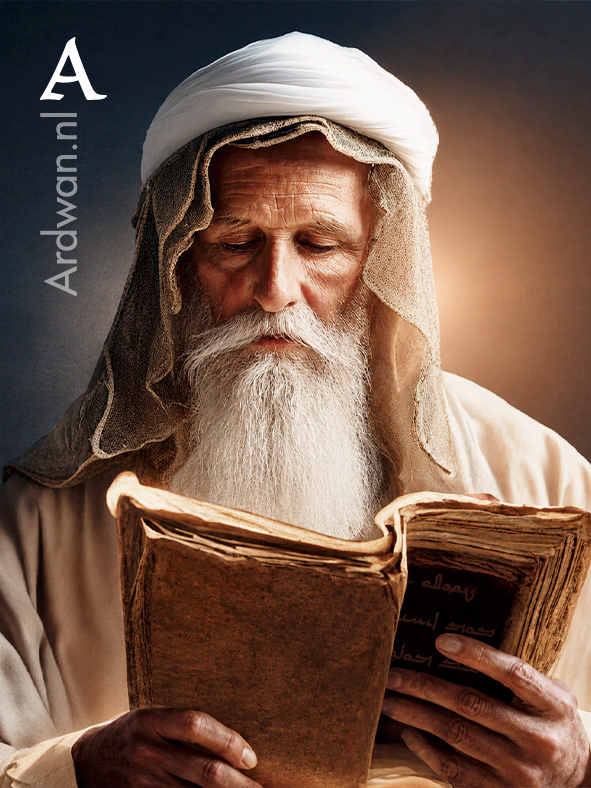
Digital interpretation of Ram Zhren, by Ardwan Al-Sabti, 2024.
In the autumn of 1831 an outbreak of cholera moved through southern Mesopotamia and through the Mandaean towns along the rivers. It killed faster than the priesthood could replace itself. Within months, in Shushtar and Dezful, in Basra and Muhammara, in Hwayza, Qurna, Nasiriyah, and Suq al-Shuyukh, every priest was gone. The chain that had carried the Mandaean tradition through the centuries broke in a single season.
One man, stood at the edge of that emptiness and chose not to walk away. His name was Ram Zhren, also known as Abdulla the Great. He was my third great-grandfather. I have read his hand for years, and I have written one manuscript in his name. I can tell you, with the care that such a claim deserves: without him, neither the priesthood nor the script as it now exists would have survived.
He was born in 1791 in Shushtar, in what is today southwestern Iran, on a tributary of the Karun. His father was a Tarmida. The line behind him was long. From childhood he had served as the Shkanda at the riverside, the ritual witness who is allowed to interrupt where the priest is not, watching everything and learning it before he had a word for what he was learning. He grew up inside the rituals. The patience that the priesthood demands had been worked into him before he was old enough to give it a name. He was forty when the cholera came.
He was a Shkanda when it came, not yet a priest. The cholera took his father, and with him every other priest in Shushtar who might have ordained him. He reached out across the rivers to his sister, who had married into a priestly family in Qurna on the Euphrates, and her husband, a Ganzibra, agreed to ordain him. Ram Zhren travelled west to Qurna for the ceremony in 1831. The cholera arrived there too. His brother-in-law died in the outbreak, and so did the other priests who had gathered for the ordination. Ram Zhren stood among them, a Shkanda still, in a tradition that no longer had any priest left to ordain him.
He did what was not supposed to be possible. From his Shkanda position, against the rule that a Shkanda must not ordain priests, he ordained others first. He built the Bit Manda alone. He taught what he had learned at the riverside, conferred the holy oil, and placed the crowns on the heads of others. Only later, when the priesthood he had rebuilt by his own hand stood firm enough to ordain him back, did his own students lay the crown on his head. The man who restored the Mandaean priesthood was ordained by the priesthood he had himself created.
What he did across the years that followed has no parallel in the modern Mandaean record. He gathered the surviving sons of the priests who had died, the boys and young men who had been mid-formation when their fathers were taken. The cholera had not only taken the priests, it had cut their teaching short. Many of these sons, when Ram Zhren brought them together, could not yet recite the Sidra d-Nishmata, the Book of Souls, the essential text spoken at every ordination. They had been raised in priestly houses, but the long, patient work of becoming a priest, the years of memorisation, the slow shaping of the hand and the breath, had been interrupted at the moment the line broke. He began with them almost from the beginning. He taught them to read the script, to write it, to recite the prayers, to perform the rites. Without that teaching, those houses would have kept their lineage but lost the practice that gave the lineage its meaning. He gave them what their fathers had not lived long enough to give.
He ordained twelve men in total. Six were Tarmidi, five were Ganzibri, one was a Puisiq. He organised them across the towns of southern Mesopotamia and southwestern Iran, and gave each of them the knowledge and the rite they needed to ordain others after him. From those twelve, by careful succession and by his patient training of their sons and his own, the Mandaean priesthood was restored across the south, from Shushtar to Suq al-Shuyukh, from Dezful to Basra. The faith, which a year earlier had nearly disappeared from the earth, was carried forward again. Every Mandaean priest alive today, in Iraq, in Iran, in the diaspora, traces a line of teaching back through that work.
He also wrote. He wrote constantly, for the rest of his life, in his own hand. He sought out every Mandaean book he could find in the surviving collections of southern Mesopotamia and southwestern Iran, and where the originals were damaged or near loss he wrote them again, line for line, in his own reed pen. By the end of his life he had produced more Mandaean manuscripts than any other scribe in the recorded history of the script. Fifty-four of his manuscripts are documented and held in collections across the world today. No other Mandaean hand in any century has left so many. When you read his hand across those manuscripts you begin to recognise its temperament. It is steady, unhurried, never decorative. He wrote like a man who knew exactly how much time he had, and exactly how much had to be done before that time ran out.
For his great work, the community gave him two titles. The first, Rishama, the head of the nation, was the formal religious office. The second, Rish-Dara, the head of the age, was not formally bestowed but religiously recognised, and not given lightly. It belonged to a man who had to carry the time itself because no one else was left to carry it with him. Ram Zhren was given both. He was the Rishama who held the nation together when the nation had almost ceased to exist, and the Rish-Dara his students named because there was no other head of the age beside him.
He died on the sixth of December 1872, in the town of Mashrah on the Tigris. He was eighty-one. He was the last Rishama the Mandaean people would have for one hundred and nineteen years. The next Rishama was his second grandson and my grandfather, Ram Yuhana, in 1992. The two men, separated by more than a century without a head of the nation, did closely related work. One restored the priesthood after a plague. The other restored the priesthood after exile. Both broke conventions to do it. The line that connects them runs through six generations, and ends, for now, with me.
I have written a Mandaean manuscript myself, in his name. It is called Ram Zihrun's Testament [ࡃࡉࡅࡀࡍ ࡊࡅࡔࡈࡀ ࡖ ࡓࡀࡌ ࡆࡉࡄࡓࡅࡍ]. It is eight hundred and sixty-five lines long, around thirty centimetres wide and roughly ten metres in length unfolded, and it was finished in 2024. I built it from his own colophons and from those of the students who outlived him. The Mandaean tradition is that a manuscript is made before it is shared, and that the making is itself the work of remembrance. He understood this. I learned it from him without ever meeting him.
What I can show on this page is the outline. The names of his teachers and his students, the towns where each ordination happened, the order in which the priesthood was built back, the lineages that came out of his twelve, all of that is held in the manuscript I wrote for him. It is not yet released. Perhaps one day it will be. Until then this page is a marker, not the record.
No photograph of Ram Zhren exists. He lived and died before photography reached southern Mesopotamia. The portrait that accompanies this post is my own interpretation of his appearance, built from the descriptions his grandchildren and sons left behind and from what the family carried forward across the generations. It is not a record. It is a reading. In my reading he wears the white robe and the high white turban of the Mandaean priesthood, with a finely woven head-cloth falling from the turban to his shoulders. His beard is long and white. His face is deeply lined. In his hands is an old codex, bound in worn fabric, the Mandaic script visible across the open page, and he is looking down into it, reading. Of all the ways I could have pictured him, that is the right one. He is holding the book he saved.
By any honest measure I have been able to find, he was the most important Mandaean of the modern era. He carried our people across the worst rupture in our recent history, and he wrote the knowledge back into existence with his own hand. I write this as his descendant and as someone who has spent years inside the work he left behind. In one of his colophons he left, in his own words, the principle that shaped everything he did:
"I, the poor servant, have written everything my eye has seen — every codex, every scroll, every commentary, every incantation. All that I found, I wrote, so that you would not lose the covenant and the knowledge."
The covenant did not break. The knowledge did not vanish. They were carried, by his hand, across a hundred years of silence, and they are still being carried now.
A note on the Mandaean priestly titles
The Mandaean priesthood is organised in grades, each with its own service and its own threshold. The titles used in this post, in ascending order, are:
Shkanda — the ritual witness who serves at the riverside, trained from childhood. Not yet a priest.
Shualia — a priest in training. Has begun the formation toward Tarmida but has not yet been ordained.
Tarmida — junior priest, ordained and authorised to perform the rites.
Rbai — master. A Tarmida who has trained a Shualia all the way to ordination as Tarmida. The mark of a priest who has not only become a priest but has now made another priest in his turn.
Ganzibra — senior priest, qualified to ordain others.
Puisiq — a Ganzibra further consecrated to perform the rites of second marriage. A specialised office within the senior priesthood.
Rishama — head of the nation. The formal religious office of the Mandaean people.
Rish-Dara — head of the age. Recognised by the community, not formally bestowed. Given only to a man who carries his time alone.
Rabania — belonging to God, exalted by God. In the Mandaean tradition this title has been given to only one man, John the Baptist.