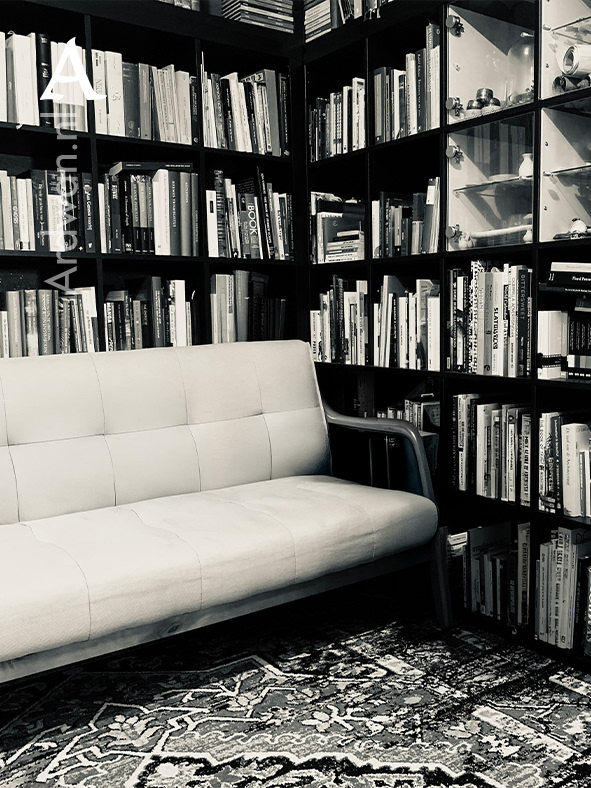
My library. The room I think in.
There is no grant. There never was. The book has been written in the hours after the day's work, on weekends, on holidays. For more than a decade.
After art school there was a phase nobody puts on a CV. I worked as a quality controller. I do not enjoy thinking about it, but leaving it out would be dishonest. Not every phase of a creative life is a showcase. Some years are simply there so you can survive them. The hand learns in those years too. Maybe more than in the years that get shown.
Today the day job is different. I design memorials for a stonemason. By coincidence, or not, it is the same company that cut my grandfather's headstone. For years I had done creative graphic work, but mostly for myself, on my own subject. What I had stayed away from was creative work done on someone else's commercial brief, for a reason I know about myself: when I commit to something, I give it everything I have. All of it. If I had taken a commercial design job after art school, I would have given that company everything too, and the Mandaic letters would not have survived it. So I chose other kinds of paid work, work that asked for my hands but not for my creative core, and the core stayed with the script. The difference here, and it is the only difference that matters, is that this is not commercial. The letters are cut for people who came because they needed them, not because someone needed to sell them something. The day job and the manuscript are no longer separate worlds. But it is still the day job. The book begins in the evening.
People sometimes ask whether it is hard to combine the two. The honest answer is that the difficulty is not the hours. The difficulty is the duration.
There is also a rhythm to it that I have learned to design rather than endure. I swim every week. I have built a ritual around it: an olive-green bag, a beige robe, olive-green slippers, a swimsuit striped vertically in black and olive green with thin pink lines running through, a cap of the right fabric. I have thought about every detail. Not because I have to. Because rhythm gives me rest, and I can only find rest in something I have designed myself. The same principle that runs through my work runs through how I unwork.
And on the other evenings, when I am at my desk and the screen is open and the manuscript pages are spread around me, my wife is in the room beside me. In silence while I work. In patience when I disappear into the work. She is simply there, and without her something would be missing that no book could replace.
This way of working is not new. It is just rare to say it out loud. Theodor Nöldeke, who wrote the grammar of my language that still stands, published in 1875, retired in 1906 in Strasbourg, lost his city after the First World War, moved to Karlsruhe, and kept writing until his death in 1930. Twenty-four years past retirement, often ill, no university, no chair, no salary, and still at work. Kurt Rudolph, whom I knew personally and visited with my father, told us once how his library had been taken from him, and how, later, the books came back. I think about that often. A scholar's library is not decoration. It is the room he thinks in.
Years after Kurt died I was browsing a second-hand bookshop in Düsseldorf. I picked up two books that day, both with his signature inside, in the way he signed all his books. One was a volume on Semitic civilizations. The other was on Mandaeism. After his death much of his library was sold. I bought both books and carried them home. They are on my shelf now. He had collected them. I now keep them.
That is something I learned from my father, Rbai Rafid. He has the largest private collection of Mandaic manuscripts in the world, but he also has almost everything that has ever been printed about Mandaeism. A whole life of careful gathering. I do the same, in my own way and on my own material. I try to own every book that touches my research, so that I always have access, so that no library closure and no archive's opening hours can stand between me and the source. A private library, built carefully over decades, is its own form of authority. It is the form available to a person who chose not to build authority through an institution.
The pandemic was, in its strange way, a gift. The world stopped moving and I could finally sit still. For the first time in years I had time. I also had the room to ask, in honest silence, whether what I was doing was enough. The doubt eventually settled, because I started asking, in ordinary conversation, the kind of questions I had been holding alone. I asked them of the Mandaic scholars I know personally, the ones I sit beside at conferences and in living rooms. The answers I got told me, more than anything else could have, that I was working on something they had not yet seen. The doubt did not return after that.
A research grant runs for three years. A postdoc, two. A PhD, four. The book I am writing has been growing for more than ten, and it will not be done this year either. There is no institution on earth whose timeline matches that. So either I let the timeline shape the work, or I work outside the timeline. I chose the second.
What it costs is obvious. Evenings. Weekends. The slow, accumulated decision to spend the few hours of energy a day leaves, after work, on the work that nobody is paying for. What it buys is the only thing it could buy. Time without an agenda. No deadline. No publication target. No committee reshaping my conclusions so they read well in a journal.
There is a kind of work that institutions can fund. There is also a kind they cannot. The first kind has a fixed shape and a fixed end. The second kind is a life.
This is the second kind. I built it this way because I had to. I have not allowed myself to imagine how it would be if I did not have to. For now I keep working.