
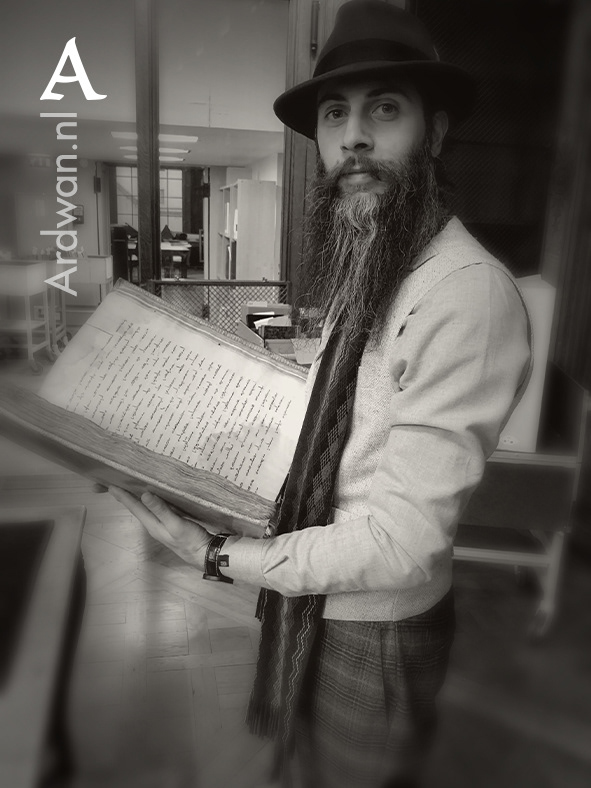
The Ginza d'Hiia of 1561 in my hands. Bibliothèque nationale de France, Paris, 2019.
Some books you read. This one I did not read. I was allowed to hold it.
In January 2019 I traveled to Paris with my wife. Not to discover anything. To stand in front of something. In the Bibliothèque nationale de France they brought out a manuscript of the Ginza, our holy book, copied by hand in 1561. It is the oldest surviving copy in the world. Even my father's collection, the largest there is, does not contain it.
It is a large book, forty-one centimetres tall, and heavier in the hands than it looks. As far as I know, I was the first Mandaean in more than four hundred years to touch those pages.
I want to be careful about how I describe this, because the temptation is to reach for big words, and the truth is smaller and heavier than any of them. The room was quiet in the particular way archives are quiet, a silence with weight to it. And in that silence I could hear the pages turn, the dry sound of paper older than any language now spoken in that room. The ink still held its line after four and a half centuries, laid down by a hand that turned to dust long ago. I did not turn the pages quickly. You do not.
There was something else. On every page I touched, a fine dust came away on my fingertips. No one had opened the book in years, perhaps far longer. I was, in some small way, the first breath of air those pages had met in a very long time.
I have spent my life around manuscripts. I grew up with them. They were as ordinary to me as the photographs in other children's books. So I did not expect to be undone by another one. But there is a difference between knowing a thing and standing inside it. Knowledge that is only read feels, to me, like a room I have seen from the outside, through a window. That day in Paris I was inside the room. I could feel the temperature.
I will not tell you what the manuscript says. That is not what this is about, and some of it belongs in work that is still unfinished. What I can tell you is what it does to you. You become very aware of your own hands. You understand, in your body and not only your mind, that this object survived everything that tried to destroy it: persecution, fire, flight, four centuries of accident. It is still here, and for one afternoon it was in front of me, and I was the one keeping it company.
A book that has outlived everyone who ever copied it, and a man who comes from the people who made it, in the same quiet room for a few hours.
You cannot get this from a description. I am giving you the description anyway, because I want you to know the day happened. But the knowing that mattered, I could only reach by being there.
And the way I write a line has not been the same since.