
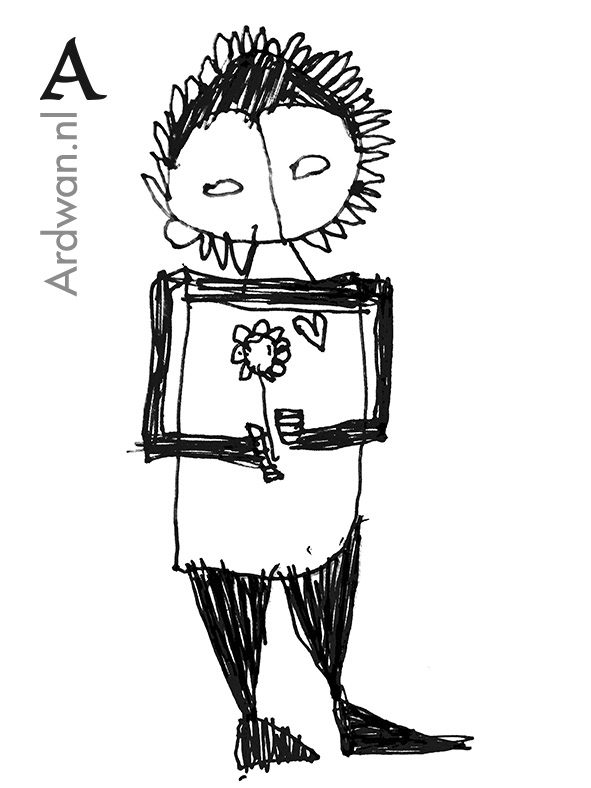
Drawing by my son, 2026
There is a moment that happens to me at work, often enough that I have begun to notice it. Something near me is not quite right. It might not be my place to question it. I am the designer. I make the work, others handle the rest. But I find I cannot stay silent. I lift my hand in the meeting. I ask. I do not enjoy doing this. Every time I think: this is not your job. Every time my mouth opens anyway. There is something in me that cannot keep still when something near me is not right.
That something is older than I am. I have come to recognise it. It is one of the small daily shapes that a much larger thing takes in my life. The much larger thing is what this post is about.
Everyone has ancestors. Hundreds of generations of them. The fact that I know twenty-three of mine by name is not, by itself, remarkable. Most people, if their families had kept careful records, could reconstruct as many. So that is not what I mean when I say I carry a tradition. Let me tell you what I do mean.
First, I do what they did. Not symbolically. Actually. The script my great-great-great-grandfather wrote in, I read. The rituals my father and his father performed at the riverside, I have stood beside as Shkanda since childhood. The manuscripts that my line copied with their hands, I grew up surrounded by in the house where I was raised. Most people whose great-grandfathers were fishermen do not fish. They work, as all people do, but the shape of their work is different. The world changes; the form of the work changes with it. That is normal. In my line, the form did not change in the same way. I work in the form my ancestors worked in, with the same script and the same iconography, translated into the materials of my time. The chain held at the level of the form of the work, not only at the level of the blood.
Second, the chain is structural. In the Mandaean priesthood, the unbroken line of teaching is not decoration. It is a working part of the religious architecture. A priesthood without that line is not a priesthood. That is why Ram Zihrun's rebuilding of the priesthood after the cholera mattered the way it did. The chain is not a story we tell about ourselves. It is the thing itself.
Third, my identity sits beneath the nation-state. Most people who carry a passport organise themselves around it. They are Dutch, German, French. The state is the first unit of self. For me it is not. I am Dutch by conviction, and I love the country that taught me to speak directly and to think with precision. But the basic ordering layer of my self is older than the Netherlands, older than the place where I now live, older than the Iraq I was born in, older than the Iran my family came from. The borders I cross every time do not register, because my self was not built around them. They are lines drawn on top of an older map.
That is what carrying means at the level of the facts. There is another level.
Carrying a tradition is not the same as preserving it. To preserve is to keep something unchanged. That is the work of museums and archives and curators. It is honourable work, but it is not what carrying is. Carrying is what happens when the thing you carry is alive and asks something of you. When you cannot stay silent because something near you is not right. When you cannot put a question down, even when you have the option to. When you do the work the world has not asked of you, because some older obligation will not let you walk away.
Every link in this chain transformed something. Every priest who copied a manuscript made small corrections in the lines. Every Tarmida who taught a Shualia translated the teaching into the language of the new student. Every Rishama who arrived in a new town adapted the practice to what the place allowed. Ram Zihrun broke a rule that his rank forbade him to break, because the chain depended on his breaking it. The chain has never been a frozen object passed from hand to hand. It has been a continuous act of small adjustments by people who knew what had to be kept and what could move.
My link will look different from theirs. It already does. I sit at a desk in a country my line never lived in, and I write in English about Mandaic so that someone who has never met a Mandaean can read it. None of my ancestors did this. That is also carrying.
It costs. I should say this honestly, because I would otherwise be writing prettily about something hard.
Not long ago I was ill for almost two weeks. I worked on the research anyway, between the sleep my body asked for and the obligation that pretends my body does not exist. I do this because I do not know how long I will live. I want there to be enough done that my son, when he is old enough to choose whether to continue, does not have to start from zero. This is not heroic. It is what every carrier I have read or known has felt. The fear is small and constant. The work continues anyway.
The cost of this is not the dramatic cost. Not the manuscripts at the bottom of a river. Not the hand cut off by an army at the door. Those costs belong to other links in other centuries. My cost is the hour my son spends elsewhere in the house while I am at my desk, writing for him. My cost is the Saturday afternoon I spend on a paragraph he could be drawing instead. No ancestor of mine had to make this exact trade, because in their time work and family did not divide the way they do in mine. This is a new shape the old obligation has taken in my link. It does not make it easier.
And there are other hours. I have made up a Mandaic Abagada song for him. It is mine; I invented it. He knows the tune now. We sit together and look at the illustrations in the manuscripts, and I teach him to draw in their style. The image at the top of this post is one he made this week. It is the first thing of his to go online.
These hours are not the desk hours. They are also not the absent hours. They are something else. They are the chain continuing, by hand, far from the rivers his forefathers lived beside, in a language his forefathers would not have recognised, with shapes his forefathers would have recognised exactly. He is just learning to write. He cannot yet read what I write. He listens to a song that has the names of letters in it. That is also carrying. The same work, the same chain, at the smallest possible scale.
The voice in me that lifted my hand in the meeting at work, the voice that kept me at this desk when I was ill, the voice that hums the alphabet to my son: it is one voice. It is older than I am. It was carried into me by twenty-three generations who could not stay still when something near them was not right. It will outlive me, in him, or in someone whose name I will not know.
Until then, I carry it. And the choice that comes with it.