
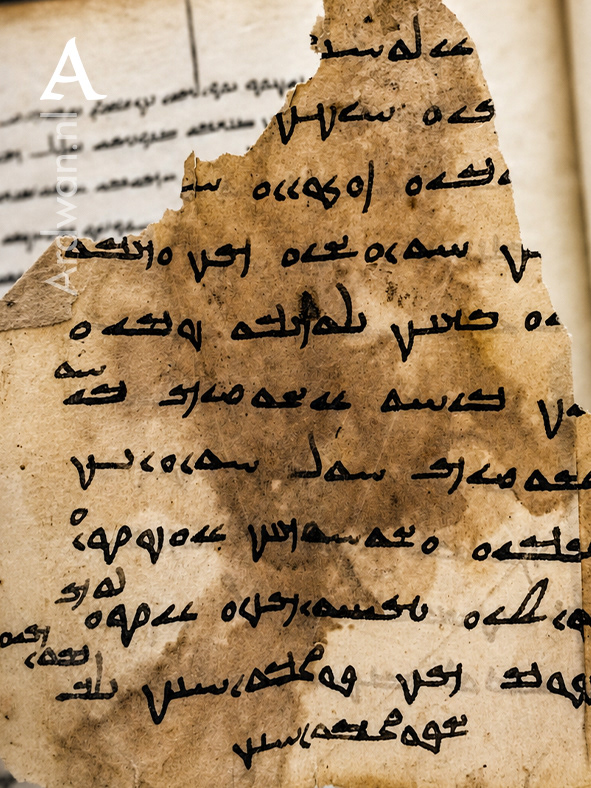
A Mandaic fragment still in circulation. Held, read, taught, two thousand years on.
If you ask why a small script in a small community in a small corner of the world should matter to anyone outside it, the honest answer is that this is the wrong question. The right question is what kind of world we want to wake up in two generations from now.
Once, the Middle East was the most script-rich region on earth. The first ledgers, the first laws, the first poems were written there, and they were written in dozens of scripts. Akkadian, Aramaic, Mandaic, Pahlavi, Hebrew, Syriac, Sabaic, Nabataean, Palmyrene, and many more. The cradle of writing, the place where people first discovered that thought could be set down in clay and ink and stone, was a place that thought in many shapes at once.
Today, almost everyone in that region writes in one script. The contraction was not the result of natural selection. It was the result of empire, conquest and policy. The point is that it happened, and that we should notice when something similar is happening in the lifetime of the people now reading this.
Mandaic is one of the few surviving voices of that older world. It is listed by UNESCO as endangered. It is classified by linguists as severely so. The community that still uses it has been scattered, generation by generation, out of southern Iraq and Khuzestan and into Sweden, Germany, Australia, the United States and the Netherlands. Researchers who track these things project that without active care, spoken Mandaic could become functionally extinct around the middle of this century.
The script may outlive the spoken language, because the script is what a scattered people reaches for first. Whether it does depends on whether someone keeps shaping the conditions in which it can be read, taught, written and printed. That is not preservation in the museum sense. It is infrastructure. Typefaces, Unicode, keyboards, primers, textbooks, fonts. The patient technical work that quietly holds a script in the modern world.
Tim Brookes, who founded the Endangered Alphabets project, puts the broader picture in plain numbers. Of the more than three hundred writing systems in the world today, somewhere between eighty-five and ninety per cent are at risk of disappearing within a generation or two. A writing system dies when a community can no longer safely pass it on. That is almost never an accident. Behind every dying script is a story of policy, displacement or fear. To save a script is to recognise the community that carries it.
This matters, even for someone who will never read a Mandaic letter, for reasons that have nothing to do with sentiment. Scripts are not interchangeable. Each one organises the hand, the eye, the page and the mind differently. A Mandaic letter is held differently, written differently, learned differently and remembered differently from a Latin one. When a script disappears, the world loses not only signs but a way of arranging meaning. It loses one more answer to the question of what writing can be.
Mandaic is also, simply, rare. Most scripts of its age are dead. Akkadian cuneiform is silent. Egyptian hieroglyphs are read only by specialists. The languages of the Phoenicians, the Sabaeans, the Palmyrenes are studied in journals, not spoken in living homes. Mandaic is close to two thousand years old, in continuous use, still taught by priests to children. There are very few writing traditions on the planet about which that sentence is true.
There is also a personal piece. I grew up in the Netherlands and built my life there. By the simple fact of where the work was made, the Mandaic script has become, among other things, a piece of Dutch heritage too. Not because the Netherlands invented it. Because someone there carried it. That is how heritage in a modern country accrues. By who is here, not only by who began things.
And so the case is not abstract. The script is on Unicode. It is on the Apple keyboard. It is in textbooks made by parents in living rooms from Stockholm to Sydney. It is being taught to children whose first written word will be Mandaic and whose second will be in some European tongue. It is, right now, one of the very few survivors of a vanished world of scripts, still alive and still in use, and we are the generation that gets to decide whether that remains true.
I have my own reasons for giving my life to this work. But the question of whether an endangered script matters is not, in the end, mine to answer alone. It is a question for whoever is reading.